
Filler Masterbatch
What is a Filler Masterbatch?
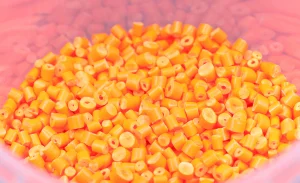
A filler masterbatch is a type of additive used in the plastics industry to reduce production costs, improve mechanical properties, and enhance the processing of plastic products. Sometimes, in the production of plastic products, it is not possible to use 100 percent of our raw materials. This issue has various reasons, the most important of which is the cost of obtaining raw materials.
Filler masterbatch is primarily composed of inorganic fillers such as calcium carbonate, talc, or barium sulfate, which make up 60% to 85% of the masterbatch composition. These fillers are mixed with a polymer carrier, usually polyethylene (PE) or polypropylene (PP), which helps ensure the uniform distribution of the filler in the final plastic product. Filler masterbatch is widely used in products when reducing raw material costs and changing physical properties is important.
Suppose producing a product requires 1 ton of polyethylene. If the manufacturer wants to procure the entire 1 ton, they would need to pay an assumed amount of $1000. However, if instead of 1 ton, they use a smaller amount of polyethylene and utilize filler masterbatch for the rest of the raw materials, the final cost would be $700 while maintaining the quality of the raw materials.
Key Features of Filler Masterbatch
Now that we are fully acquainted with this material, let’s review some of its features. Besides cost reduction, there are other interesting capabilities worth discussing:
Cost reduction: The primary feature of this material is that it significantly reduces the cost of plastic production by substituting a portion of the polymer resin with filler.
Improved stiffness: This material increases the rigidity and strength of the plastic product.
Dimensional stability: It provides better control over shrinkage and warping of plastic products during and after processing.
Good processing efficiency: It enhances flow properties of polymers and makes processing in extrusion, injection molding, and blow molding applications easier.
Main Applications of Filler Masterbatch
Due to its economic features and benefits to plastic products, filler masterbatch is used in various industries. Common applications include:
Packaging: Used in the production of plastic films, bags, and containers to reduce material costs while preserving product integrity.
Construction industry: Used in the production of pipes, fittings, and profiles to enhance strength and reduce costs.
Automotive parts: Utilized in non-structural parts to increase stiffness and reduce production costs.
Household items: Employed in items like plastic furniture, containers, and toys where a balance between cost, strength, and appearance is required.
Textiles: Used in the production of non-woven fabrics and synthetic fibers to improve dimensional stability and reduce production costs.
Advantages of using filler masterbatch
By using this material, manufacturers can expect the following:
Economic Efficiency: By replacing a portion of the polymer with a filler, manufacturers can significantly reduce material costs without compromising product quality.
Improvement of Mechanical Properties: Increases the rigidity, tensile strength, and durability of plastic products.
Process Improvement: Helps achieve better flow and extrusion rates, leading to more efficient manufacturing processes.
Environmental Impact: Reducing the amount of polymer used can decrease the carbon footprint of the final product and contribute to more sustainable manufacturing practices.
Customizable Formulation: Filler masterbatches can be designed to meet specific needs, such as increasing fire resistance or improving surface quality.
Challenges and Considerations
Despite its advantages, the use of filler masterbatches comes with some challenges:
Impact on Flexibility: High filler content can reduce the flexibility and stretch of the final product, which may not be desirable in all applications.
Color and Appearance: The addition of fillers may affect the color and clarity of the plastic, which can be a concern in certain aesthetic applications.
Process Considerations: Excessive filler content may lead to processing difficulties, such as increased wear on machinery or challenges in achieving uniform smoothness.
Compatibility: The choice of filler and polymer carrier must be carefully matched to ensure compatibility and optimal performance.
Future Trends in Filler Masterbatches
The future of filler masterbatches is influenced by advancements in materials science and increasing demand for cost-effective and sustainable solutions in the plastics industry. New trends include the development of new types of fillers, such as bio-based or recycled materials, which offer similar benefits while reducing environmental impacts. Additionally, interest in nanocomposites is also growing, where nanoscale fillers are used to enhance mechanical properties without significantly changing the weight or appearance of the plastic.
Technological innovations in dispersion techniques and carrier polymers are also expected to improve the performance and usability of filler masterbatches, making them applicable for a wider range of industries.
in the end…
Filler masterbatches are a valuable tool in the plastics industry, providing a cost-effective way to enhance the mechanical properties and processing of plastic products. In this article, we aimed to discuss the main characteristics of this material. Its applications are vast, ranging from packaging materials and construction to automotive parts and household goods. As this industry continues to evolve with a focus on sustainability and performance, filler masterbatches will remain a vital component in achieving these goals.
Manufacturers who embrace the latest advancements in filler technology and customize their formulations to meet specific market needs will succeed in the competitive global market. By balancing cost, performance, and environmental impact, filler masterbatches can contribute to the production of high-quality, durable, and sustainable plastic products.
If you need consultation for supplying and ordering this product, you can connect with our colleagues through this link.
Showing all 5 resultsSorted by latest


